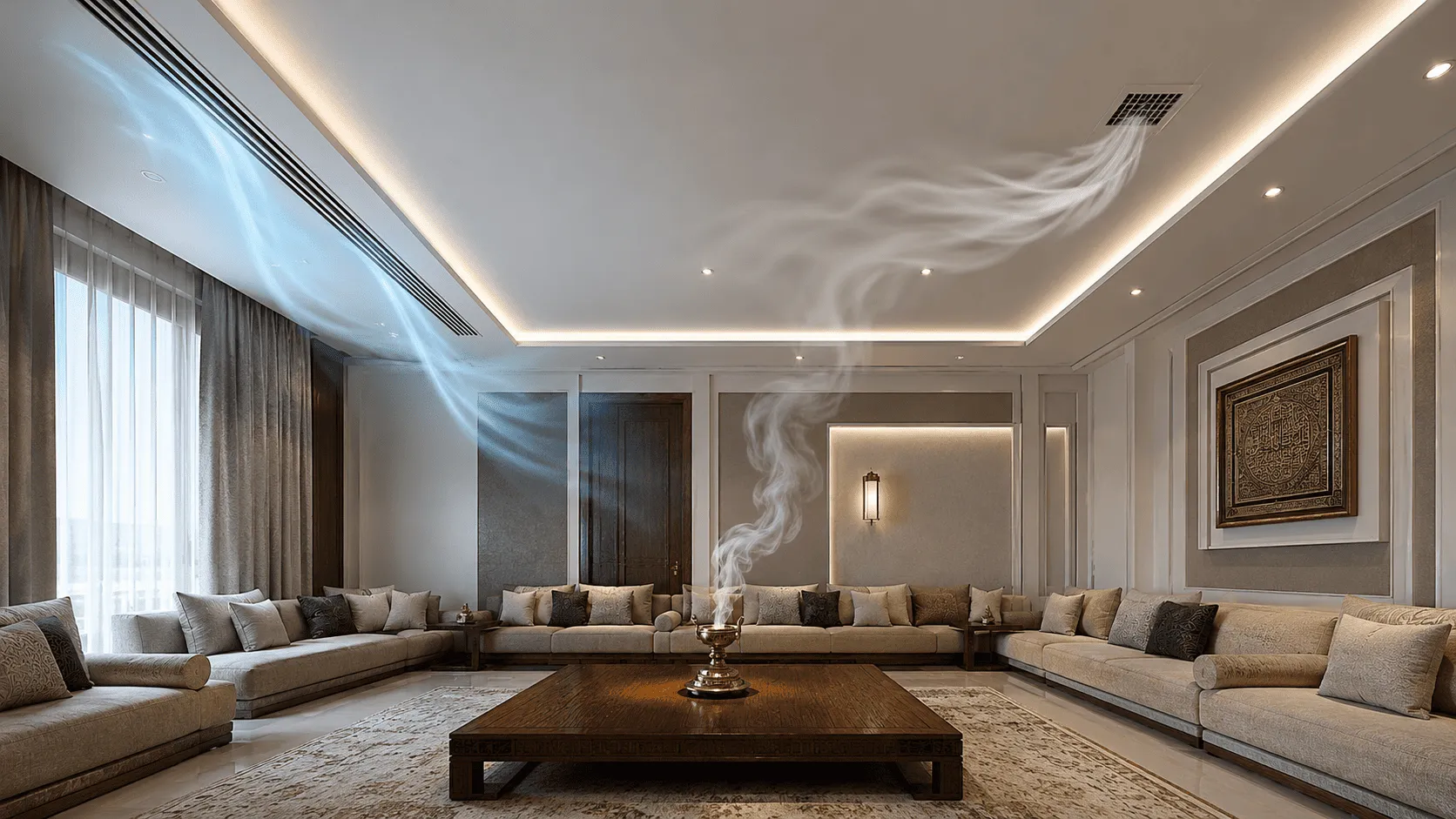
Your kitchen exhaust system is the “lungs” of your restaurant—any weakness in its design can drain your budget through inefficient air conditioning, poor capture, and recurring maintenance. Cyberia’s recommended approach is a complete commercial kitchen exhaust system that delivers strong extraction and balanced make-up air, even under the toughest operating conditions.
In today’s guide, we’ll cover:
- How to design the kitchen exhaust ductwork and extraction layout from the ground up.
- How to identify zones that require high-capture exhaust (grease, smoke, heat, odors).
- The difference between a “basic restaurant hood” and a fully engineered hood, fan, and make-up air system.
- Key specs for restaurant exhaust fans built for long-duty operation in commercial kitchens.
- The role of an oven-area exhaust fan in removing concentrated heat and improving comfort.
- How to diagnose weak extraction and set realistic installation scope and cost drivers (duct resistance, filters, balancing, access, and maintenance).
Why does exhaust design come before opening day?
Your restaurant’s success isn’t only about the food; it also depends on a safe, efficient kitchen environment, and that starts with proper commercial kitchen ventilation design. A well-planned commercial kitchen exhaust system protects comfort, hygiene, and HVAC efficiency from day one.
Core components of a commercial kitchen exhaust system
- Kitchen exhaust hood (over cooking line): The hood sits above cooking equipment to capture and contain rising smoke, heat, and grease-laden vapors before they spread through the kitchen air.
- Exhaust ductwork (duct system): The kitchen exhaust duct is the airflow route that carries odor, heat, and grease-laden air from the hood to the exterior discharge point.
- External discharge point (exhaust outlet): The final exhaust discharge location—roof, façade, or a designated shaft—defined by the site plan and safe routing requirements.
- Restaurant exhaust fan (exhaust blower): Installed either in-line within the duct run or at the discharge end (often roof-mounted), the fan provides the required extraction force to move air effectively through the system.
Why do restaurant exhaust fans matter?
A properly designed restaurant kitchen exhaust system is what controls heat levels, odor spread, and overall HVAC stability from day one. Here’s how:
1) Exhaust and staff comfort in the kitchen
When specifying restaurant exhaust fans, the design should ensure:
- Source capture of steam, smoke, and grease-laden vapors directly above the cooking line.
- Reduction of excessive heat buildup above stoves and cooking equipment.
- Less fatigue and irritation caused by breathing contaminated air.
Weak extraction turns the kitchen into a demanding work environment, which can negatively affect production quality and order speed.
2) Exhaust and odor control in the dining area
Good exhaust planning keeps kitchen odors away from dining tables. Poor design, on the other hand, often leads to odor migration through entrances or cooling openings—annoying guests even if the food is excellent.
3) How exhaust affects air conditioning performance
Unstable extraction increases stress on air conditioning. Without balanced make-up air, strong exhaust can create negative pressure that pulls conditioned air out of the dining area—disrupting air distribution and reducing cooling effectiveness.
What are the common problems with restaurant exhaust performance?
- Delaying duct routing: When ductwork is postponed, tight site constraints often force longer runs, extra bends, and awkward offsets—which increases static pressure and weakens the actual capture/extraction performance from day one.
- Ignoring maintenance access: Installing the system without proper clean-out access panels for ducts and filters makes servicing difficult and accelerates grease buildup over time.
- Skipping make-up air: Exhausting air without a controlled make-up air (replacement air) supply creates negative pressure, affects air conditioning performance, and can worsen odor migration.
With Cyberia’s experience in commercial kitchen exhaust systems in Kuwait, you get a clear duct route, balanced make-up air, and well-planned service access points. Contact us now and share your kitchen layout to receive an execution-ready recommendation before opening.
Also read: Centrifugal Fan: How They Work and How to Maximize Efficiency
Zoning restaurant exhaust fans by cooking areas
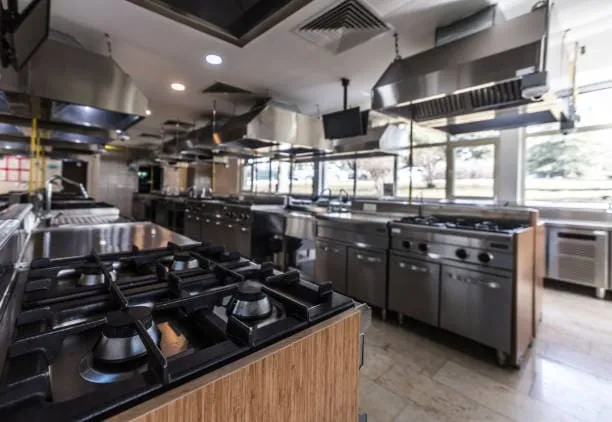
Before designing an effective commercial kitchen exhaust system, you need to identify the zones that generate the highest heat, vapors, and grease during daily operation:
- Frying and grilling stations: Typically produce the highest levels of smoke and grease-laden vapors. These zones require stronger source capture exhaust to remove contaminants before they spread across the kitchen.
- Oven and range line: Generates continuous heat that affects staff comfort and HVAC stability, so extraction must be sized to help maintain a more stable kitchen temperature.
- Hot prep area: Some equipment releases dense steam during cooking. This area needs adequate exhaust to prevent moisture accumulation and reduce humidity in the space.
- Multi-appliance cook lines: When multiple appliances sit on one line, the ventilation load increases. You’ll need balanced exhaust distribution across the entire hood length—often more effective than relying on a single extraction point.
- Low-load zones: Areas such as storage or cold prep usually don’t produce heavy grease or dense fumes. In many cases, general ventilation is sufficient without high-capacity exhaust.
Why do exhaust requirements vary across kitchen zones?
Exhaust demand isn’t the same in every part of a commercial kitchen. The differences usually come down to these core factors:
- Equipment type: Fryers and grills generate far more grease, smoke, and cooking fumes than light heating equipment, so they require higher kitchen exhaust airflow and stronger capture.
- Heat output: Some stations raise indoor temperature rapidly and need more intensive extraction to stabilize the working environment.
- Steam and moisture load: Hot cooking can release dense steam; without adequate commercial kitchen ventilation, moisture can condense and odors can linger.
- Contaminant concentration (grease/smoke): Certain corners create heavier grease-laden vapors that deposit inside ducts, raising hygiene issues and increasing fire risk over time.
- Number of cooking points on one line: Combining multiple appliances under one hood or along a single cookline increases the total required airflow and makes balanced exhaust distribution more critical.
- Operating hours and production intensity: High-output, continuous-operation sections typically need stronger restaurant exhaust fan capacity than intermittent or low-use areas.
- Interaction with air conditioning: Some areas are affected by supply air jets or cooling patterns and may require tuned exhaust rates to prevent odors from migrating toward the dining area.
How to set exhaust priorities in your restaurant kitchen?
Use these questions to evaluate each kitchen zone and decide where stronger source capture is needed:
- Does this station create odors that reach the dining area?
- Does it release airborne grease that deposits on walls and surfaces?
- Do you feel suffocating heat above the cooking line despite air conditioning?
- Does this area require frequent cleaning because of grease buildup?
If the answer is “yes” to more than one question, that zone typically needs higher exhaust capacity, a stronger kitchen hood extraction design, and in some cases large restaurant exhaust fans, depending on output and operating hours.
At Cyberia, we engineer exhaust point distribution with a practical, data-driven approach, distinguishing between oven heat loads and fryer grease intensity to build a calmer, cleaner, and more comfortable kitchen environment. Contact our team to get an integrated HVAC and kitchen ventilation plan for your restaurant in Kuwait.
Also read: Bathroom Exhaust Fan: Silent & Concealed Types and the Best Installation Method
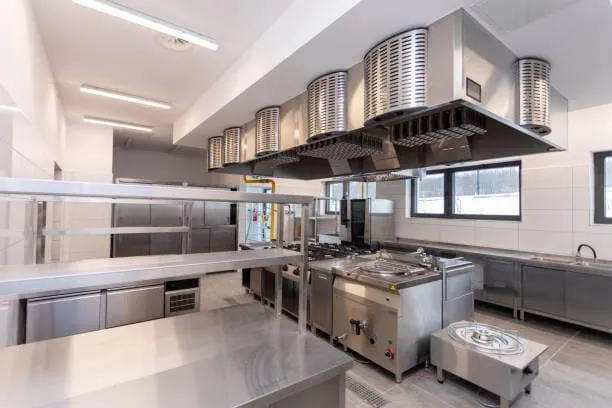
How to choose a restaurant exhaust fan built for long operating hours?
When selecting a restaurant exhaust fan that will run for many hours every day, focus on specifications that deliver durability and stability—not just high extraction power.
- Heavy-duty motor: Choose a motor designed for continuous operation to maintain efficiency and reduce overheating risk.
- Robust, grease-resistant housing: A solid casing with suitable protection helps resist grease buildup, corrosion, and humidity common in commercial kitchens.
- Precision-balanced impeller: A properly balanced fan wheel reduces vibration and noise and helps extend motor and bearing life.
- Service-friendly design: Prioritize models with easy access to internal components so inspections and maintenance can be done quickly.
- Heat-tolerant components: The fan should handle sustained high temperatures from intensive cooking and oven discharge air.
- Proper duct compatibility: Full alignment with duct dimensions and system resistance helps maintain airflow and prevents the fan from operating under excessive strain.
How to know if a fan is going wrong way?
If you notice any of the following, the fan is often mismatched to the real operating load (airflow + static pressure + heat/grease conditions):
- Noticeable overheating in the fan housing or motor.
- Strong vibration or abnormal noise during operation.
- Extraction performance drops after only a short period of running.
- Frequent shutdowns due to overload or thermal protection trips.
How does Kuwait’s climate affect the lifespan of restaurant exhaust fans?
In Kuwait, dust and humidity accelerate grease buildup inside the restaurant exhaust fan and the kitchen exhaust ductwork. As deposits increase, system resistance (static pressure) rises and operating temperatures go up, reducing efficiency and shortening service life. That’s why it’s important to:
- Follow a consistent cleaning schedule for the fan, hood filters, and ductwork.
- Protect the external discharge point with proper weather shielding and safe discharge detailing.
- Ensure duct joints and connections are tightly sealed to reduce dust ingress and leakage losses.
In practice, the local environment can affect fan lifespan almost as much as daily operating hours.
The role of exhaust systems in cooling restaurant kitchens
In professional kitchens, an oven exhaust fan (and the wider commercial kitchen exhaust system) is one of the most effective tools for controlling heat, improving team comfort, and reducing strain on air conditioning. To understand why, start with this key question:
Why do ovens increase the heat load inside a kitchen?
An oven generates two types of heat:
- Direct radiant heat you feel when standing near the equipment.
- Rising hot air that lifts upward and accumulates above the cooking zone.
If that hot air is not extracted quickly, it spreads through the kitchen and overwhelms cooling equipment—often without delivering real comfort gains.
Benefits of an oven exhaust fan
A correctly sized restaurant exhaust fan above oven zones can:
- Prevent heat from spreading across the kitchen, supporting more stable temperatures.
- Extract hot air directly above the oven, improving comfort for chefs and operators.
- Reduce the thermal load on air conditioning and cut energy waste by limiting unnecessary cooling demand.
- Remove steam and grease-laden vapors before they condense on walls and surfaces—supporting a cleaner kitchen environment.
- Improve overall airflow balance and help prevent negative pressure when integrated with adequate make-up air.
Common mistakes that reduce heat-extraction effectiveness
- Placing the hood/exhaust pickup too far from the heat source, which allows hot air to disperse and weakens capture efficiency.
- Using ductwork with too many sharp elbows, which increases static pressure and reduces fan performance.
- Replacing the fan while ignoring duct routing and make-up air issues—because the root problem is often the system design, not the fan alone.
How to improve exhaust performance without changing the fan?
Before replacing a kitchen exhaust fan, try these practical steps—often the lowest-cost way to fix weak extraction with minimal disruption:
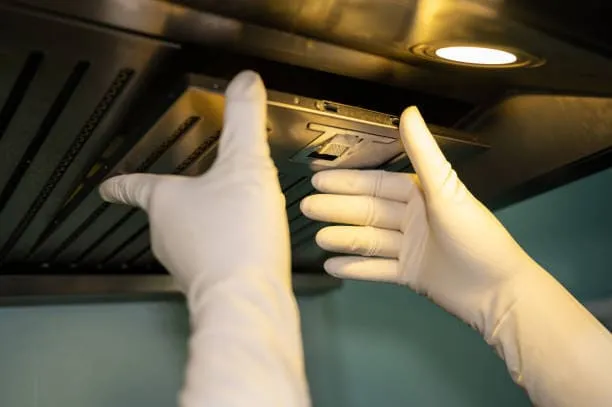
- Clean grease filters and the collection tray thoroughly to keep airflow paths open.
- Inspect and clean the kitchen exhaust ductwork internally to reduce resistance and remove hazardous grease buildup.
- Check bends and duct joints for leaks, restrictions, or poor transitions that weaken extraction “pull.”
- Verify the outdoor discharge cap is clean and unobstructed to prevent backdrafting or outlet restriction.
- After electrical work, confirm the motor rotation direction so the fan runs at its intended performance.
- Provide sufficient make-up air (replacement air) to prevent negative pressure and stabilize the entire exhaust process.
- Inspect belts and bearings regularly to maintain correct speed and reduce vibration.
- Observe smoke travel above equipment to confirm capture, balance, and stable airflow patterns.
If you complete the steps above and extraction is still weak, then replacing the fan—or redesigning the ductwork and make-up air strategy becomes a logical next step. In most restaurant kitchens, the issue is rarely “just the fan”—it’s the complete system.
Also read: Industrial Ventilation Fans: Ventilation Solutions for Factories and Warehouses
What drives the cost of installing restaurant exhaust fans in Kuwait?
The total cost isn’t defined by the fan price alone. In a commercial kitchen exhaust system, installation cost is shaped by several technical factors you should understand:
1) Design and airflow path (ductwork)
This is often the biggest cost driver because it defines the scope of on-site works:
- Number of elbows/bends and how complex the duct route is.
- The actual duct length from the hood to the external discharge point.
- Duct sealing quality to reduce air leaks, vibration, and performance losses.
- Whether clean-out access panels are included (or need to be added later) for easier duct cleaning.
- The discharge location (wall vs. roof), and its orientation relative to wind and fresh-air intakes.
2) Equipment and components
Component selection changes cost depending on durability and operating demands:
- Hood type and capture area above cooking equipment.
- Noise and vibration control elements based on site requirements.
- A backdraft damper to prevent reverse airflow and odor return—especially in windy conditions.
- Protective accessories such as weather discharge caps and dust protection.
- Fan type and placement: in-line vs. roof-mounted / end-of-line exhaust fan.
- Whether you need large restaurant exhaust fans for higher loads or multi-line cooklines.
3) Site conditions and installation constraints
The same design can be easier or harder to build depending on site realities:
- Difficult roof access, working at height, or tight spaces.
- Architectural constraints that prevent a direct route—forcing longer runs or extra offsets.
- Coordination with other services (HVAC, plumbing, electrical) within the same ceiling/shaft space.
- Hidden routes inside false ceilings or behind finished areas that require opening and reinstatement.
4) Operation, grease load, and maintenance planning
In restaurants, daily cooking creates requirements that affect both design and cost from the start:
- Preventing grease accumulation that causes early performance drop or unplanned shutdowns.
- Grease intensity (frying/grilling) and the need for suitable grease filters and cleanable ductwork.
- A practical cleaning and maintenance plan with accessible service points—rather than repeated dismantling.
- Operating hours and daily runtime, which determine the need for continuous-duty components.
At Cyberia, we deliver cost-effective engineering solutions by installing commercial kitchen exhaust fans and systems built for continuous operation and real kitchen loads. Contact our engineers in Kuwait for a precise cost estimate tailored to your restaurant’s layout and ventilation requirements.
Cyberia: Restaurant HVAC & Ventilation Experts in Kuwait
Cyberia specializes in engineering cooling and air extraction systems designed to handle Kuwait’s extreme heat and high humidity, so commercial kitchens can maintain stable indoor air quality (IAQ) and reliable day-to-day performance.
We deliver fully integrated solutions for commercial kitchen HVAC and restaurant exhaust ventilation, combining air conditioning with advanced restaurant exhaust fans based on a precise study of ductwork routing and external discharge points.
Our approach targets the root causes of odor issues and weak extraction by tuning system performance on site to match real operating conditions.
Cyberia and Kuwait’s climate challenges
Local conditions require design decisions that Cyberia addresses from the start:
- Handling severe outdoor heat that increases the cooling load inside commercial kitchens.
- Protecting discharge outlets from sandstorms and dust to keep airflow stable and uninterrupted.
- Specifying heavy-duty components built for continuous operation in high-demand facilities.
Cyberia’s execution methodology
We apply a structured process that supports ventilation stability from day one:
- Site diagnosis: Evaluate cooking zones and the duct route using field checks aligned with project drawings.
- Engineering recommendation: Define fan capacity and select the most suitable exhaust system design for the project size and cooking load.
- Quality installation: Professional installation to reduce vibration and ensure accessible maintenance points.
- Performance testing: Measure air velocity and verify actual extraction strength before handover.
- Ongoing support: Provide practical guidance to sustain performance and reduce preventable breakdowns over time.
FAQs about restaurant exhaust fans
How can I tell if weak extraction is caused by the ductwork—not the fan?
If smoke or odors leak from ceiling points, or you feel air pushing back from the outlet, the issue is often duct leakage, poor routing, or excessive resistance—not the fan itself. Start by checking duct sealing, joint integrity, and bend quality (elbows/transitions) before replacing the exhaust fan.
How do I know if a restaurant exhaust fan can’t handle long operating hours?
Common signs include overheating, noticeable vibration, abnormal noise, or performance that drops over time. In many kitchens, the cause may be grease buildup on the impeller, filters, or ductwork—not a fan defect—so inspection and cleaning should come first.
Do I need a separate oven exhaust fan from the main hood system?
Sometimes improving capture around the oven within the main hood, duct, and fan system is enough. In other cases, a dedicated solution is required based on oven location, heat load, and the discharge route. The right decision depends on the kitchen layout and production intensity.
When is external discharge necessary for restaurant kitchens?
External discharge is often essential when grease and odors are high, the space is enclosed, or internal filtration alone isn’t sufficient. Venting outdoors reduces odor buildup, but it requires well-sealed kitchen exhaust ductwork and a suitable backdraft damper to prevent reverse airflow and odor return.